


If you arrive in Budapest by airport bus, there’s a good chance your first stop will be Elizabeth Square. And it’s a great place to start.
Erzsébet tér is one of the most central and lively spots in the city. It sits next to Deák Ferenc tér, where the three main metro lines meet, and it’s within walking distance of landmarks like St. Stephen’s Basilica and the Danube. Locals meet here, travelers take a break, and the Budapest Eye is hard to miss. In practice, it’s the kind of place you pass through more than once during your trip.
What makes Elizabeth Square interesting is the contrast in one space. One side feels like a quiet park with trees and open areas, while the other is more modern, with the Ferris wheel and the Akvárium Klub hosting events and nightlife.
In this guide, we’ll show you what to see, how to visit, and whether the Budapest Eye is really worth it, so you can decide how to include this stop in your itinerary.

What is Elizabeth Square in Budapest?
Elizabeth Square (Erzsébet tér) is one of the main central squares in Budapest and one of the easiest places to recognize when you first arrive in the city.
Located in District V, right next to Deák Ferenc tér, the square sits above the only interchange where metro lines M1, M2, and M3 meet. This makes it one of the most practical points in Budapest to start exploring the city.
But what makes Erzsébet tér different is not just its location. It’s one of the few open, green spaces in central Pest, where you can slow down between visits. In most cases, it naturally becomes a stop during the day, whether you planned it or not.
You might pass through after visiting the Basilica, sit down for a short break, or end up here again in the evening without even noticing.
What makes Erzsébet tér different from other squares?
Unlike more formal squares in Budapest, Erzsébet tér feels relaxed and informal. It’s not built around a single monument or historical building. Instead, it works as an open space where different parts of the city come together.
One side of the square has a more traditional park feel, with trees, paths, and the Danubius Fountain. The other side is more modern, with wide open areas, the Budapest Eye, and the Akvárium Klub just below ground level.
This contrast is what gives the square its identity. It’s not just a place to “see,” but a place to spend time.
What is Elizabeth Square known for?
Elizabeth Square is known for combining different elements in one place. The Budapest Eye is the most visible landmark and attracts most visitors at first. At the same time, the Akvárium Klub brings a younger crowd, especially in the evening, while the green areas make it easy to relax during the day.
In practice, it’s this mix between sightseeing, local life, and open space that makes Erzsébet tér one of the most useful and pleasant spots to include in your Budapest itinerary.
Where is Elizabeth Square in Budapest?
If you look at a map, you’ll notice something quickly: this spot is one of the most strategic locations in the entire city. Many of the main attractions are either within walking distance or just one metro stop away.
Here are a few key distances to give you a clear idea:
- St. Stephen’s Basilica → about 3-4 minutes on foot
- Vörösmarty Square (main shopping area) → around 5-6 minutes
- Danube promenade → less than 10 minutes
- Chain Bridge → about 10 minutes walk
This makes Erzsébet tér a natural starting point for your day. You can plan your itinerary without needing to rely too much on transport, especially if you enjoy walking.
How to get to Elizabeth Square
Getting to Elizabeth Square is simple, even if it’s your first time in Budapest.
By airport bus (100E):
The easiest option if you arrive by plane. The 100E Airport Express stops at Deák Ferenc tér, just next to the square. In many cases, this will be your first contact with the city.
By metro:
You can use any of the three main lines:
- M1 (yellow line)
- M2 (red line)
- M3 (blue line)
All of them stop at Deák Ferenc tér, with exits that lead directly to the square.
On foot:
If you’re staying in central Pest, you’ll likely reach Elizabeth Square without even planning it. It connects naturally with the main streets, shopping areas, and landmarks.
Even without a map, there are two clear visual references:
- the Budapest Eye, which you can see from a distance
- the constant flow of people moving in and out of the square
Once you reach Deák Ferenc tér, just follow the signs for “Erzsébet tér” or “Budapest Eye,” and you’ll be there in less than a minute.
After your first visit, you won’t need directions anymore. If you want a clearer overview of how the system works, check our guide on public transport in Budapest, including metro lines, tickets, and tips.
Why is it called Erzsébet tér?
Elizabeth Square is named after Empress Elisabeth of Austria, known as Sisi, one of the most loved historical figures in Hungary.
The name “Erzsébet tér” comes from the Hungarian version of Elisabeth. The square was officially named in 1858, during the time when Budapest was growing into a modern European capital.
Who was Elisabeth (Sisi)?
Empress Elisabeth was the wife of Emperor Franz Joseph I of the Austro-Hungarian Empire. But in Hungary, she was not seen simply as an empress.
She was admired because she showed real interest in Hungarian culture and people. She learned the Hungarian language, spent time in the country, and supported Hungarian political autonomy at a time when tensions with Vienna were strong.
This explains why her name appears in several places across the city, not just here, but also on bridges and monuments.
Why is she important for Hungary?
Sisi is often linked to one key moment in Hungarian history: the Austro-Hungarian Compromise of 1867, which gave Hungary more independence within the empire.
While she was not a politician, her relationship with Hungarian leaders and her support for the country helped shape that period. This created a strong emotional connection between her and the Hungarian people.
Even today, she is remembered more as a “Hungarian queen” than as an Austrian empress.
Did the square always have this name?
No, and this is where things get interesting.
Like many places in Budapest, the name of the square changed several times during the 20th century, reflecting political shifts:
- It was renamed Stalin Square after World War II
- Later changed to Engels Square during the socialist period
- Finally returned to Erzsébet tér in 1990 after the fall of communism
This makes the square not just a central location, but also a small reflection of Hungary’s modern history.
What does the name mean today for visitors?
Today, the name is mostly a cultural reference, but knowing the story behind it adds another layer to your visit.
When you walk through Elizabeth Square, you’re not just in a park or a meeting point. You’re also in a place that connects different moments of Hungarian history: from the imperial era to the communist period and into modern Budapest.
What to see and do in Elizabeth Square
Budapest Eye (Ferris wheel Budapest)
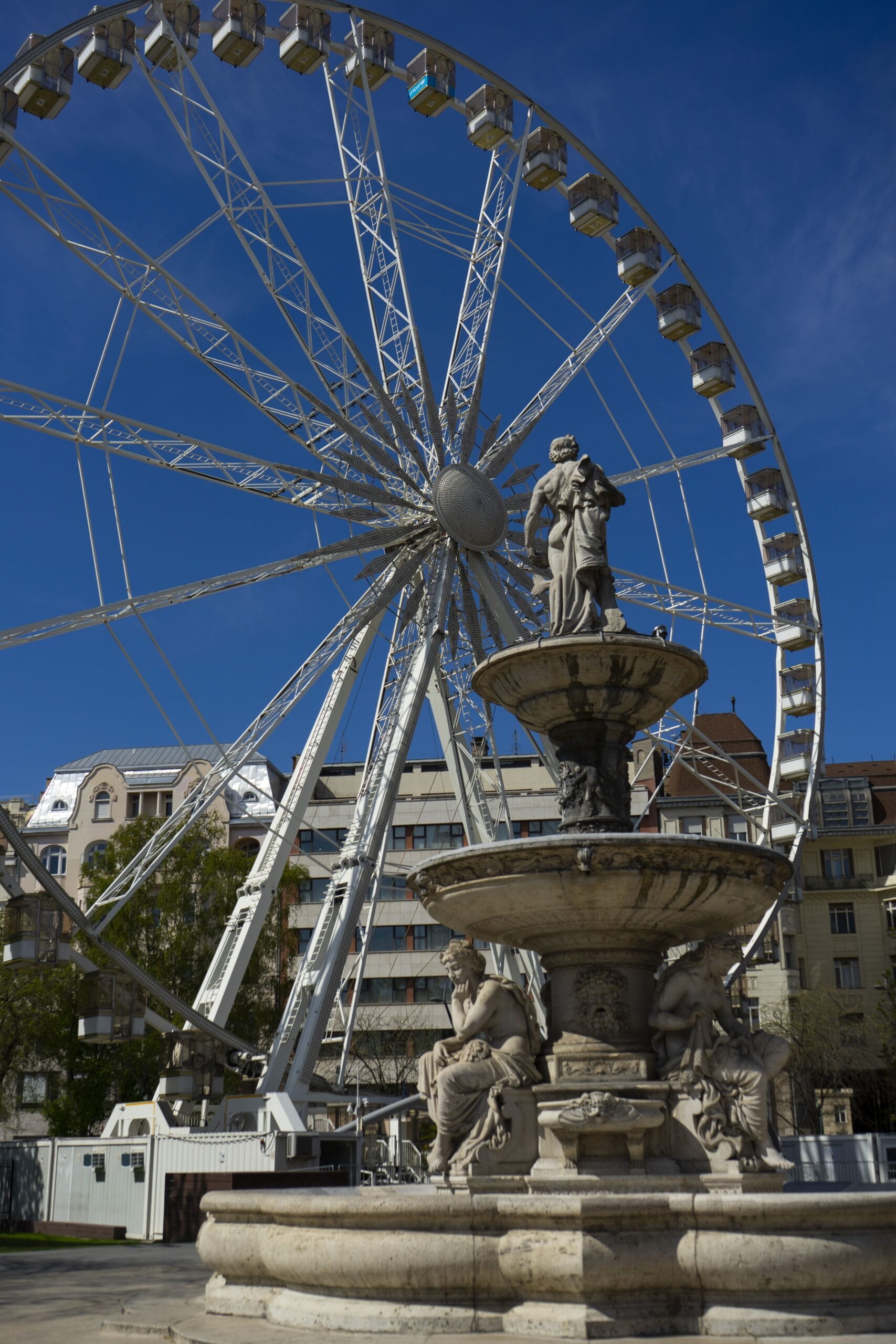
This is the most visible landmark in the square and one of the most photographed spots in the city. The Budapest Eye stands around 65 meters high and offers a wide view over the center.
From the top, you can see:
- St. Stephen’s Basilica
- the rooftops of Pest
- parts of the Danube and Buda
We’ll go into details about price and whether it’s worth it in the next section, but visually, it defines the square.
Danubius Fountain
On the opposite side of the square, you’ll find a completely different atmosphere.
The Danubius Fountain is a historic monument from the late 19th century, designed by Miklós Ybl. It represents the main rivers of Hungary and adds a more classical feel to this part of the park.
This is a quieter area, with trees and benches, and it’s one of the best spots in the square if you just want to sit down for a few minutes.
Akvárium Klub and the terrace
Under the modern side of the square, you’ll find the Akvárium Klub, one of the main cultural and nightlife venues in Budapest.
Even if you’re not planning to go inside, the area above it is worth visiting. The terrace is often full of people, especially in spring and summer, and creates a very social atmosphere.
You’ll notice:
- people sitting on the grass
- small groups having drinks
- events and music in the background
This is where the square becomes more dynamic, especially in the evening.
Green areas and open space
One of the main reasons people come here is simply the space itself.
Elizabeth Square is one of the few green areas in central Pest, and it works almost like a small urban park. During the day, you’ll see:
- locals relaxing on the grass
- travelers taking a break between visits
- people walking through as part of their route
Overall, it’s one of the best places in the city center to pause without needing to go to a café or restaurant.
Design Terminal and surrounding area
Right in the middle of the square, you’ll notice a modernist building that used to be a bus station and is now known as the Design Terminal.
It’s not always open for visitors, but it’s an interesting detail that separates the square into two parts: one more traditional, one more modern.
Around it, you may also find small markets (like design or craft events) and skate areas with informal hangout spots.
What is the best way to experience Elizabeth Square?
The best way to experience it is simple: don’t rush it.
A good plan could be:
- Walk through the square after visiting the Basilica
- Take a short break near the fountain or on the grass
- Come back in the evening when the lights and atmosphere change
Elizabeth Square is not about ticking boxes. It’s about taking a moment in the middle of your day and enjoying the rhythm of the city.
Budapest Eye: prices, opening hours and is it worth it?
The Budapest Eye is the main attraction in Elizabeth Square and one of the most visible landmarks in the city center. Even if you don’t plan to ride it, you’ll likely pass by it several times during your trip.
From our experience, it’s one of those activities that feels more like a “nice extra” rather than a must-do, but in the right conditions, it can be a great moment of your visit.
How much does the Budapest Eye cost?
Ticket prices are not the cheapest compared to other activities in Budapest, and this is usually the main factor to consider.
Here’s a quick overview:
| Ticket Type | Price (approx.) |
|---|---|
| Adult | 4,900 HUF (~13 €) |
| Child (2–12) | 2,900 HUF (~8 €) |
| Priority ticket | ~6,900 HUF |
| VIP / extras | Higher depending on option |
A standard ride includes about 3 rotations and lasts 8-10 minutes.
The price is acceptable if you’re looking for a relaxed panoramic view, but less so if you’re expecting a long or “special” experience. For further information, check the official site.
What are the opening hours of the Budapest Eye?
The Budapest Eye operates daily, all year round.
Typical hours:
- Sunday to Thursday: 11:00 – 23:00
- Friday and Saturday: 11:00 – 24:00
Opening hours can change slightly depending on the season, so it’s always a good idea to check before you go.
What is the view like from the Budapest Eye?
The ride is slow and smooth, more like a moving viewpoint than an attraction.
From the top, you get a 360-degree view of central Budapest. The experience changes depending on the time of day:
- Daytime: clearer visibility, good for photos
- Sunset: probably the best moment, with warm light over the city
- Night: the city lights create a very different atmosphere
Sunset is the best balance if you can time it right.
Is the Budapest Eye worth it?
This is one of the most common questions.
Yes, if:
- you want an easy panoramic view without climbing stairs
- it’s your first time in Budapest
- you enjoy relaxed experiences rather than fast attractions
Maybe not, if:
- you’re on a tight budget
- you already plan to visit other viewpoints (like the Basilica dome or Gellért Hill)
- you expect a long or “thrilling” ride
We’d suggest seeing it as a short, scenic break rather than a main highlight.
How much time do you need to visit Elizabeth Square?
You can visit Elizabeth Square in 15-20 minutes, but it’s worth staying longer if you want to relax or enjoy the atmosphere.
Unlike other attractions in Budapest, Erzsébet tér is not a place with a fixed route or a list of must-see interiors. It’s an open space, so the time you spend here depends entirely on how you use it.
Most visitors fall into one of these three scenarios.
Quick stop (15-20 minutes)
If you’re following a tight itinerary, a short stop is enough to get a feel for the square.
In this time, you can:
- walk across the square
- take photos of the Budapest Eye
- see the Danubius Fountain
- get a quick sense of the atmosphere
This works well if you’re moving between nearby attractions like the Basilica or the Danube.
Relaxed visit (30-60 minutes)
This is probably the most common option.
With a bit more time, you can:
- sit on the grass or near the fountain
- take a proper break between visits
- enjoy a drink nearby or on the terrace
- watch the daily life of the city
This is when Elizabeth Square starts to feel more interesting. You’re no longer just passing through, you’re actually experiencing it.
Full experience (1-2 hours)
If you decide to include the Budapest Eye or spend time in the area, your visit can easily extend.
In this case, you might:
- ride the Ferris wheel
- stay for sunset or evening atmosphere
- combine the square with nearby streets and cafés
This works especially well if you’re not in a rush and want a slower pace during your day.
When is the best time to visit?
The experience changes depending on the time of day:
| Time of day | What to expect |
|---|---|
| Morning | Quiet, fewer people, more relaxed |
| Afternoon | Lively but still comfortable, good for a break |
| Evening | More crowded, social atmosphere, nightlife nearby |
Late afternoon is probably the best balance. You can enjoy the square without too many crowds and still stay as the atmosphere becomes more dynamic in the evening.
Is it worth planning time for it?
Yes, but not as a standalone attraction.
Elizabeth Square works best as a natural pause in your itinerary rather than a fixed stop. You don’t need to dedicate a full visit to it, but you should leave space in your day to enjoy it properly.
Sometimes, the best moments in Budapest are not the ones you plan in advance, and this square is a good example of that.