


- On 2 June, 2026
- In Places to see
- Tags: danube promenade budapest, holocaust memorial budapest, jewish history budapest, shoes on the danube, Shoes on the Danube Bank, shoes on the danube budapest, shoes on the danube history, shoes on the danube meaning, shoes on the danube memorial, Things To Do in Budapest
What Is the Shoes on the Danube Memorial?
More than just a monument, the Shoes on the Danube is one of the most meaningful historical sites in Budapest.
Before planning your visit, here is a quick overview of the most useful practical information about the Shoes on the Danube, including location, transport options and the best time to visit.
| Practical Information | Details |
|---|---|
| Location | Danube Promenade, District V |
| Entry Fee | Free |
| Opening Hours | Open 24/7 |
| Closest Metro | Kossuth Lajos tér (M2) |
| Closest Tram | Tram 2 |
| Recommended Visit Time | Sunset or evening |
| Average Visit Length | 20–45 minutes |
What are the Shoes on the Danube?
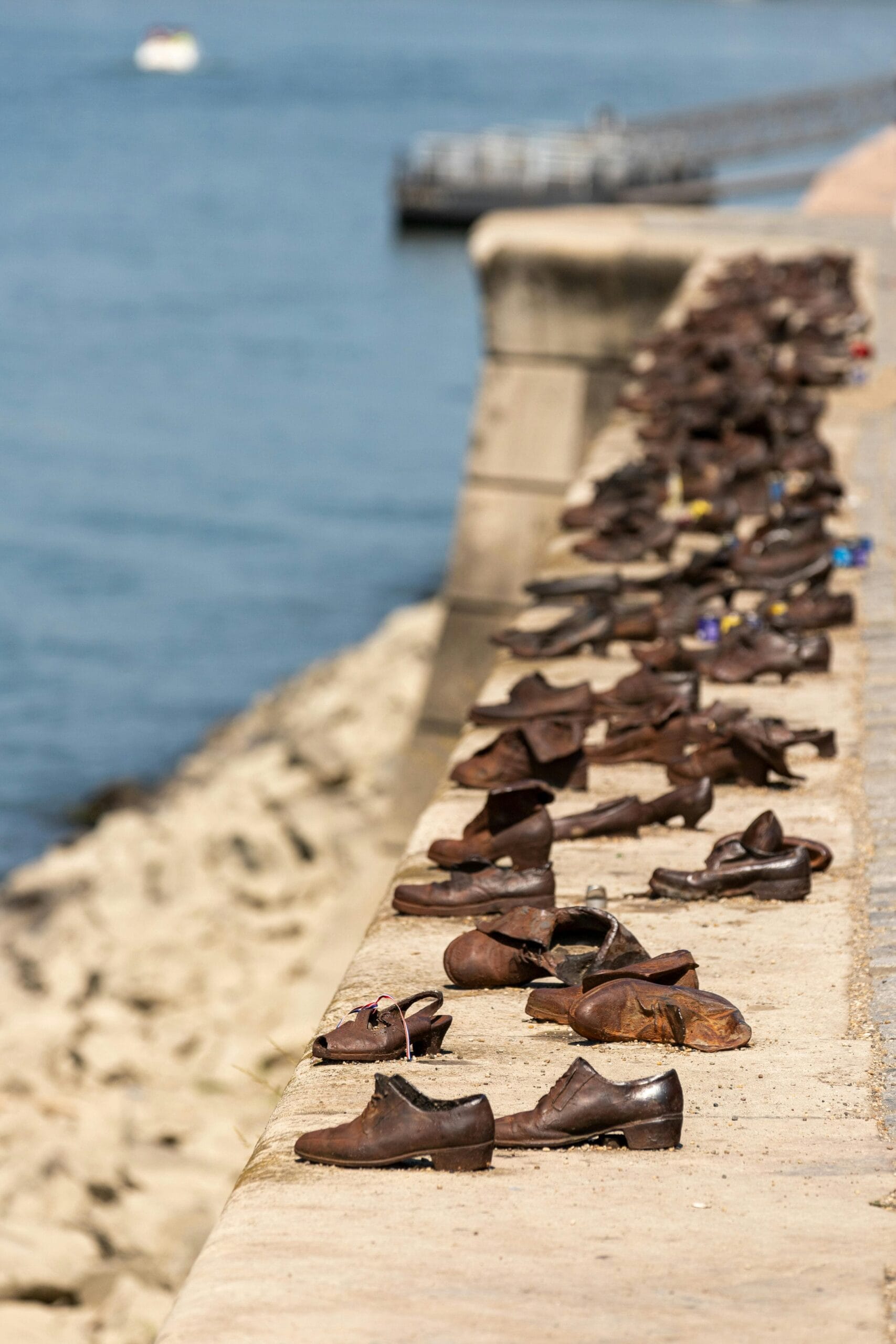
The Shoes on the Danube is a Holocaust memorial located on the Pest side of Budapest, directly on the banks of the Danube River. The memorial consists of 60 pairs of iron shoes placed along the edge of the promenade, near the Hungarian Parliament. Today, it is considered one of the most important memorials in Hungary connected to World War II and the persecution of Hungarian Jews.
The installation was inaugurated in 2005 and was designed to create a direct and emotional connection with the events that took place on this exact riverbank during the winter of 1944-1945.
Who created the memorial?
The memorial was created by Hungarian film director Can Togay together with sculptor Gyula Pauer. Their goal was to create a simple but deeply moving monument that could communicate the tragedy of the Holocaust without using large statues or traditional heroic symbolism.
Instead of focusing on abstract forms, they chose everyday objects that immediately feel human and personal. This minimalist approach is one of the reasons why the memorial has become so internationally recognized.
Why are there iron shoes on the riverbank?
The iron shoes represent the victims who were forced to remove their shoes before being executed on the banks of the Danube. During World War II, shoes were valuable items that could be sold or reused, so victims were ordered to leave them behind before being shot.
The installation includes different types of footwear from the 1940s, including men’s boots, women’s shoes and children’s shoes. The scattered arrangement of the shoes makes the scene feel immediate and deeply personal, as if the owners had only just stepped away from them.
The History Behind the Shoes on the Danube
Before becoming one of Budapest’s most visited memorials, the Shoes on the Danube marked the location of one of the darkest episodes in the city’s history. Understanding what happened here during World War II helps explain why the memorial remains so powerful today.
What happened in Budapest during 1944-1945?
During the final months of World War II, Budapest became the scene of brutal violence against the Jewish population of Hungary. After Germany occupied Hungary in 1944, the fascist Arrow Cross Party took power and introduced a period of terror across the city.
Thousands of Hungarian Jews were persecuted, deported or murdered in Budapest during this period. The Danube riverbank became one of the places where executions were regularly carried out, especially during the winter of 1944-1945.
Who were the Arrow Cross militia?
The Arrow Cross Party was a Hungarian fascist and strongly antisemitic movement led by Ferenc Szálasi. Its members were responsible for violent attacks, executions and mass killings in Budapest during the final phase of the war.
Arrow Cross militiamen often moved through the streets of Budapest searching for Jewish victims. Many people were taken directly from homes, shelters or from the Budapest Ghetto and brought to the banks of the Danube.
Why were people shot beside the Danube River?
The Danube River was used as a mass execution site because it allowed the bodies of victims to be carried away by the current. Before being executed, victims were usually forced to remove their shoes, which were considered valuable during wartime and could later be sold or reused.
Groups of men, women and children were lined up along the riverbank and shot at the water’s edge. In many cases, victims were tied together so that when one person was shot, the others would fall into the freezing river as well.
How many victims are connected to the memorial?
The exact number of victims executed along the Danube in Budapest is unknown, but historians estimate that thousands of people were murdered on the riverbank during this period. The memorial specifically commemorates the Jewish victims killed by Arrow Cross militiamen in 1944-1945.
Today, the Shoes on the Danube site remains one of the clearest reminders of the Holocaust in Hungary and of the violence that took place in the center of Budapest during World War II.
Why the Shoes on the Danube Is So Powerful
The symbolism of the shoes, the silence of the Danube and the central location in the city all contribute to the strong emotional reaction many visitors experience here.
Why are there different styles and sizes of shoes?
One of the most striking details of the memorial is the variety of shoes placed along the riverbank. Visitors can see men’s boots, women’s heels, work shoes and children’s footwear, all inspired by styles commonly worn during the 1940s.
This detail reminds visitors that the victims were not anonymous numbers. They were ordinary people with families, professions and daily lives. The presence of children’s shoes is especially heartbreaking and helps communicate the human scale of the tragedy in a very direct way.
Why do the empty shoes feel so emotional?
The Shoes on the Danube memorial symbolizes loss, memory and the human cost of hatred and intolerance. Unlike large monuments or statues, the memorial feels personal and intimate because it focuses on objects connected to everyday life.
The empty shoes create the impression that their owners suddenly disappeared. Standing beside them, directly on the riverbank where the executions happened, makes the experience even more intense for visitors.
Today, the riverside installation has become an important place of remembrance not only for Hungary’s Jewish community, but also for visitors from around the world who come to learn more about the Holocaust and Budapest’s wartime history.
Why does the memorial affect visitors so deeply?
Many people describe the Shoes on the Danube as one of the most emotional places they visit in Budapest. Part of this impact comes from its simplicity. There are no dramatic sculptures or large historical explanations. Instead, the memorial allows visitors to imagine the people who once stood there.
The location also plays an important role. The contrast between the peaceful Danube promenade and the violence that happened there during World War II creates a strong emotional reaction. Seeing the river flowing quietly beside the empty shoes makes the history feel very real and immediate.
Why do people leave candles and stones?
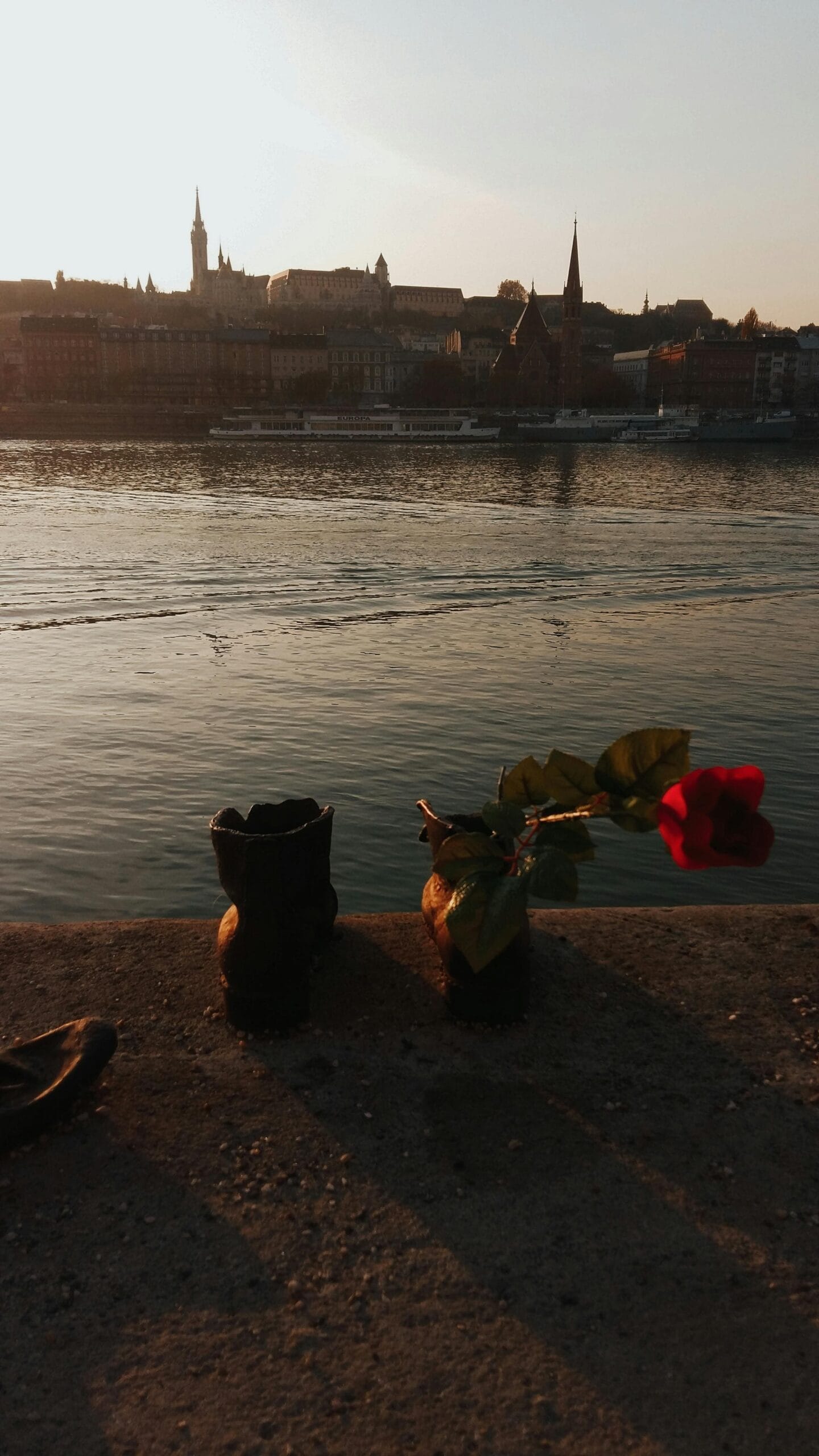
Visitors often leave candles, flowers and small stones beside the shoes as a sign of remembrance and respect. In Jewish tradition, placing stones on graves or memorials is a way to honor the memory of the deceased and show that they have not been forgotten.
Over the years, these small gestures have become part of the memorial itself and help create a quiet and reflective atmosphere along the riverbank.
After understanding the history and symbolism behind the memorial, many visitors want to know how to include it in their Budapest itinerary.
Where Are the Shoes on the Danube Located?
One of the reasons why the memorial is included in so many Budapest itineraries is its central location along the Danube promenade. It is easy to reach on foot and can be combined with several major attractions nearby.
Shoes on the Danube location
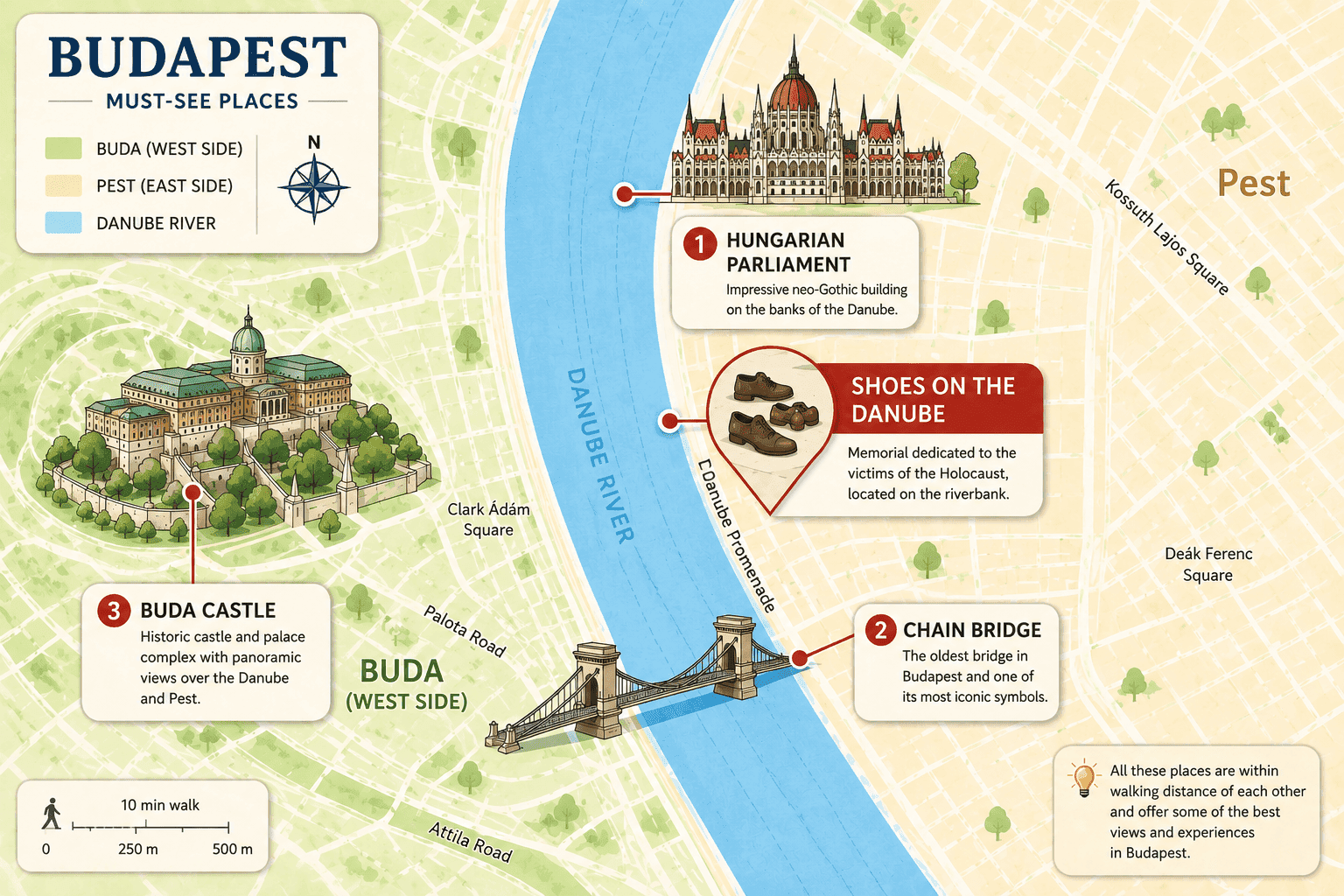
The Shoes on the Danube is located on the Pest side of Budapest, directly along the Danube promenade between the Hungarian Parliament and the Chain Bridge. The memorial sits on the riverbank at Id. Antall József rakpart, one of the most scenic walking areas in the city.
Because of its central position, the memorial is very easy to include while exploring other major attractions in Budapest.
How far is it from the Hungarian Parliament?
The memorial is only a short walk from the Hungarian Parliament Building, located around 300 meters south of Parliament along the riverfront. Walking between the two locations usually takes less than 5 minutes.
Many visitors combine the memorial with a visit to the Parliament area, especially since the riverside promenade offers beautiful views of the Buda Castle, the Fisherman’s Bastion and the Danube.
How to get to the Shoes on the Danube
Reaching the memorial is simple thanks to Budapest’s public transport system and walkable city center. If you are already staying in District V or near the Danube promenade, you can easily reach it on foot.
The memorial is also included in many walking routes.
From the Hungarian Parliament
The memorial is located only a few minutes south of the Hungarian Parliament Building. The walk takes around 5 minutes and follows the riverside promenade, offering beautiful views across the Danube toward the Buda side of the city.
Because of the short distance, many travelers visit both locations together during the same walk through District V.
From Chain Bridge
Walking from the Chain Bridge to the Shoes on the Danube usually takes around 10-15 minutes along the riverbank. This route is especially popular in the evening, when both the bridge and Parliament are illuminated.
The promenade between these landmarks is flat, scenic and ideal for photography.
From St. Stephen’s Basilica
From St. Stephen’s Basilica, the walk to the memorial takes approximately 15 minutes. The easiest route passes through the elegant streets of central Pest before reaching the Danube promenade near Parliament.
This is a convenient option for visitors exploring Budapest’s historical center on foot.
From Fisherman’s Bastion and Buda Castle
If you are visiting the Fisherman’s Bastion or Buda Castle, you can reach the memorial by crossing the Danube via the Chain Bridge or Margaret Bridge. Depending on the route, the journey usually takes between 25 and 35 minutes on foot.
Nearest metro and tram stops
The closest metro station is Kossuth Lajos tér on the M2 metro line (red line). From there, the memorial is just a few minutes away on foot.
Another excellent option is Tram 2, one of the most scenic tram lines in Budapest. The tram runs directly along the Pest riverfront and stops close to the memorial, making it an easy way to visit while exploring the Danube area.
Shoes on the Danube and Budapest’s Jewish History
The Shoes on the Danube memorial is deeply connected to the broader history of Budapest’s Jewish community during World War II. Visiting the site often leads travelers to explore other important places connected to the Holocaust and Jewish heritage in the Hungarian capital.
The connection with the Budapest Ghetto
During the final months of World War II, thousands of Jews in Budapest were forced into the Budapest Ghetto, located in today’s Jewish Quarter. Many victims executed along the Danube were taken from ghettos, safe houses or temporary detention sites across the city.
Today, the former Jewish Quarter remains one of the most historically significant parts of Budapest. Visitors can still see important landmarks connected to Jewish history, including the Dohány Street Synagogue, memorial plaques and former ghetto streets.
Other Holocaust memorials nearby
The Shoes on the Danube is often visited together with other Holocaust-related sites in Budapest. One of the most important is the Holocaust Memorial Center, which documents the persecution and deportation of Hungarian Jews during World War II.
Another important stop is the Tree of Life Memorial behind the Dohány Street Synagogue. The metal tree contains the names of Holocaust victims and has become another important place of remembrance in the city.
Why Holocaust remembrance remains important in Budapest
Today, this place serves not only as a historical monument, but also as a reminder of the consequences of hatred, antisemitism and political extremism. For many visitors, seeing the empty shoes beside the Danube creates a much stronger personal connection than reading historical facts alone.
Because of this, the Shoes on the Danube remains one of the most visited and respected memorials in Budapest, attracting people from around the world who want to better understand the city’s history and honor the memory of the victims.
Visiting the Shoes on the Danube at Night
Many visitors consider the evening the best time to experience the Shoes on the Danube. After sunset, the atmosphere along the river becomes quieter and more reflective, while the illuminated Parliament building creates one of the most memorable views in Budapest.
Is it worth visiting after sunset?
Yes, visiting the site at night offers a very different experience compared to daytime. The crowds are usually smaller, the riverfront is calmer and the lights of the city create a more intimate atmosphere around the iron shoes.
For many travelers, this quieter setting makes it easier to stop, reflect and fully understand the emotional weight of the location.
What does the site look like at night?
At night, the lights from the Hungarian Parliament reflect across the Danube and illuminate the promenade nearby. The contrast between the beautiful nighttime scenery and the tragic history connected to the site makes the experience especially powerful.
The riverside walkway is generally well lit and remains accessible throughout the evening since the installation is open 24 hours a day.
Best time for photos and quieter moments
The best moments to visit are usually:
- early morning
- sunset
- later evening hours
These times tend to offer fewer crowds and softer lighting for photography. Sunset is particularly popular because visitors can see the Parliament transition from daylight into its nighttime illumination.
Since the area is directly beside the river, it can also become windy during colder months, especially in winter evenings, so dressing warmly is recommended.
What to Expect During Your Visit
Visiting the Shoes on the Danube is very different from visiting a traditional tourist attraction. There are no ticket offices, guided entrances or exhibition halls. Instead, the experience is quiet, open and personal, allowing visitors to spend time reflecting beside the riverbank at their own pace.
How long does a visit take?
Most visitors spend between 20 and 45 minutes at the site. Some stop briefly while walking along the Danube promenade, while others take more time to read the plaques, observe the details of the shoes and reflect on the history connected to the location.
Because the installation is outdoors and centrally located, it is easy to combine with nearby attractions such as Parliament, the Chain Bridge or the Jewish Quarter.
Is the site free to visit?
Yes, the Shoes on the Danube is completely free to visit and remains accessible 24 hours a day throughout the year. There are no tickets, reservations or entrance gates.
This open access is part of what makes the riverside installation feel so immediate and connected to everyday life in Budapest.
How should visitors behave respectfully?
The site is considered a place of remembrance and mourning, so respectful behavior is expected. Visitors should avoid:
- climbing on the shoes
- sitting inside the installation
- taking playful or staged photos
- speaking loudly around the riverbank
Many people visit the site to quietly reflect or honor the memory of the victims.
Accessibility and practical tips
The promenade beside the Danube is flat and paved, making the area generally accessible for wheelchair users and visitors with strollers. However, the river’s edge can become narrow when crowded.
You will often notice candles, flowers and small stones placed beside the shoes by visitors. If you wish, you may also leave a small stone as a sign of remembrance, following Jewish mourning traditions.
Since there are no facilities directly beside the site, it is best to use nearby cafés or public services around the Parliament area before your visit.
Why the Shoes on the Danube Remains One of Budapest’s Most Important Sites
Among the many historical landmarks in Budapest, the Shoes on the Danube leaves a particularly strong impression on visitors. Its power does not come from size or grand architecture, but from the way it transforms a quiet section of the riverbank into a place of memory and reflection.
More than twenty years after its inauguration, the installation continues to remind people of the human stories behind the Holocaust in Hungary and the violence that took place in Budapest during World War II.
The simplicity of the iron shoes makes the experience deeply personal. Visitors are not looking at abstract symbols or distant historical figures. Instead, they are confronted with everyday objects connected to ordinary lives that were suddenly interrupted.
Today, the site attracts people from around the world who come not only to learn about Budapest’s history, but also to reflect on the consequences of hatred, intolerance and political extremism. For many travelers, it becomes one of the most emotional and memorable stops in the city.
If you want to better understand the history behind places like the Shoes on the Danube, joining a local walking tour can add important historical and cultural context to your visit. Our Free Walking Tour of Budapest explores the city’s main landmarks while explaining the key events that shaped Budapest through the centuries, including World War II and the communist era.
For visitors interested in the Holocaust history of Budapest and the stories connected to the former ghetto, the Jewish Quarter Free Walking Tour offers a deeper look into the city’s Jewish heritage, wartime history and the locations that continue to preserve the memory of the victims today.
Even in a capital known for its architecture, thermal baths and nightlife, the Shoes on the Danube stands apart as a place that encourages silence, remembrance and respect.